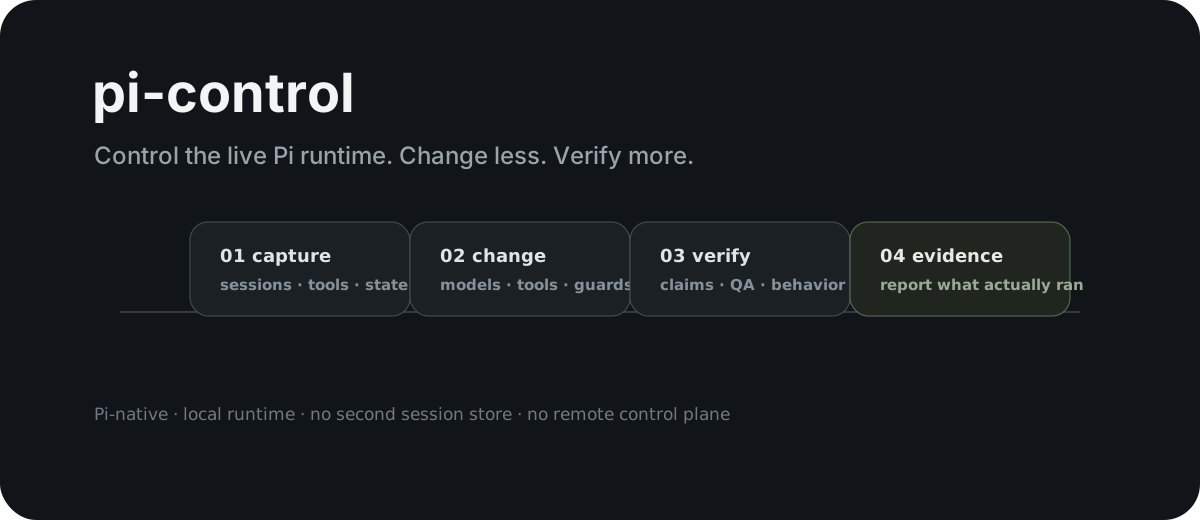
A Pi extension that gives humans and coding agents a control plane over the live Pi process — agent sessions, model switching, tool gating, saved runtime state, QA verification, and guardrails — with every change backed by evidence from the same process it controls.
pi-control does not replace Pi's agent runtime, spawn daemons, or mirror state into a second store. It operates directly on Pi's own session tree, model registry, tool inventory, and state history, then verifies what actually happened.




- 5 agent tools —
pi_session,pi_model,pi_tool,pi_state,pi_verify - 3 operator commands —
/pi-demo,/pi-verify,/pi-qa - Guardrails — destructive shell and unsafe mutation patterns are denied before execution
- 1 packaged skill —
pi-controloperating discipline (capture → change → verify → report) - No telemetry, no daemon, no second runtime — in-process against the live Pi host
Persistent (all Pi sessions):
pi install npm:@groeponline/pi-controlOne session only:
pi -e npm:@groeponline/pi-controlPi loads both the extension and the packaged skill from the package manifest — no extra configuration.
Verify a claim about the runtime:
{"tool":"pi_verify","action":"session","expectations":{"entries.gt":5}}Switch model and thinking level, then confirm:
{"tool":"pi_model","action":"thinking","level":"high"}{"tool":"pi_verify","action":"model","expectations":{"thinkingLevel":"high"}}Snapshot state before a risky change, restore it after:
{"tool":"pi_state","action":"save","key":"before-refactor","data":{"phase":"baseline"}}{"tool":"pi_state","action":"restore","key":"before-refactor"}Gate the toolset for a bounded run:
{"tool":"pi_tool","action":"set_active","tools":["read","bash"]}| Command | Purpose |
|---|---|
/pi-demo |
Demonstrate a concrete Pi workflow or feature with explicit scope, model, and verification commitments. |
/pi-verify |
Test a claim about Pi runtime behavior and report evidence. A well-evidenced "this does not work" is as valuable as a pass. |
/pi-qa |
Run a structured QA flow step by step and report PASS/FAIL with evidence. |
| Action | Description |
|---|---|
list |
List available sessions. |
inspect |
Show current session details (entry count, branch, model). |
fork |
Fork from an entry into a new session. |
switch |
Switch to another session. |
compact |
Compact the current session. |
navigate |
Move through the session tree. |
label |
Set or clear a label on an entry. |
rename |
Rename the session. |
| Action | Description |
|---|---|
list |
List available models. |
providers |
Show registered providers. |
set |
Switch the active model. |
thinking |
Change the thinking level. |
| Action | Description |
|---|---|
list |
Show all tools and their active/inactive status. |
inspect |
Show details for a specific tool. |
set_active |
Replace the complete active tool set. |
set_activeis a replacement, not a toggle: it defines the full set of active tools. Inspect first, then set the smallest set you need.
| Action | Description |
|---|---|
save |
Save a named snapshot of runtime state (label, summary, data). |
restore |
Restore a saved snapshot. |
diff |
Compare two state snapshots. |
history |
Show the change history. |
| Action | Description |
|---|---|
session |
Assert session properties (entry counts, model, settings). |
model |
Assert the active model and thinking level. |
tool |
Assert tool output matched expectations. |
state |
Assert state snapshot properties. |
Lifecycle and tool-call hooks deny unsafe control patterns before execution, including:
- destructive filesystem operations (
rm -rf /,rm -rf ~,mkfs,dd if=) - fork-bomb patterns and remote-to-shell piping (
curl … | sh,wget … | sh) - unsafe session mutations, gated behind explicit confirmation hooks
The operating rule the skill enforces: inspect first, make the smallest change, then verify.
capture (pi_session inspect / pi_state save)
  → change (fork / switch / set / thinking / set_active)
    → verify (pi_verify)
      → report (evidence from the same Pi process)
Every state-changing action is deliberate: switching models, replacing tools, restoring state, or moving between sessions affects the current Pi process. The packaged pi-control skill documents this discipline for agents.
pi-control owns runtime control and verification. The wider GroepOnline Pi suite:
| Package | Role |
|---|---|
@groeponline/pi-wishcraft |
Operator cockpit: powerline status bar, session queue, Skill Studio, ideas inbox |
@groeponline/pi-missions |
Durable missions that survive context resets |
@groeponline/pi-agent-control-extension |
Browser/terminal capture, QA evidence recipes, showcase rendering |
@groeponline/pi-tools |
Shared Pi tooling |
The flow: idea (pi-wishcraft) → durable mission (pi-missions) → execution → runtime & evidence verification (pi-control / pi-agent-control-extension).
extensions/pi-control/
  index.ts        extension entrypoint — registers commands, tools, guardrails
  tools.ts        the five structured agent tools
  guardrails.ts   lifecycle and tool-call safety hooks
  commands/       /pi-demo, /pi-verify, /pi-qa
skills/pi-control/
  SKILL.md        packaged operating guidance
# package contract (manifest, resources, Pi peer rules, tarball contents)
npm run verify:package

# extension unit tests
npm ci --prefix extensions/pi-control
npm test --prefix extensions/pi-control
The verify:pi-package gate validates the npm/Pi package contract end to end: manifest, declared resources, public metadata, gallery preview format, Pi core peer-dependency rules, and the final packed tarball. CI runs it on every PR and before every publish.
pi-control collects no telemetry and sends nothing to external services. It operates on the local Pi process; all state and evidence stays under the operator's control.
Does it change how Pi works by default? No. It adds commands, tools, and guardrails on top of the standard runtime. Anything that mutates state happens only when a tool call or command asks for it.
Can I use the tools without the commands? Yes. The commands are operator workflows on top of the same five tools; agents can call the tools directly.
Does it work with any model?
pi_model operates on whatever models and providers your Pi installation has registered. It switches and verifies; it does not bundle providers.
Where does state live?
In Pi's own runtime state, managed through pi_state snapshots. There is no external database or sidecar.
- Pi catalog: https://pi.dev/packages/@groeponline/pi-control
- npm: https://www.npmjs.com/package/@groeponline/pi-control
- Source: https://github.com/GroepOnline/pi-control
- Issues: https://github.com/GroepOnline/pi-control/issues
- Architecture: ARCHITECTURE.md · Changelog: CHANGELOG.md
MIT © GroepOnline