








CS undergrad at San Francisco Bay University building agent and developer infrastructure — systems that let an autonomous agent touch something that matters and then prove it did the right thing. Five shipped this year; all public, all MIT.


Email · LinkedIn · LeetCode · Codeforces



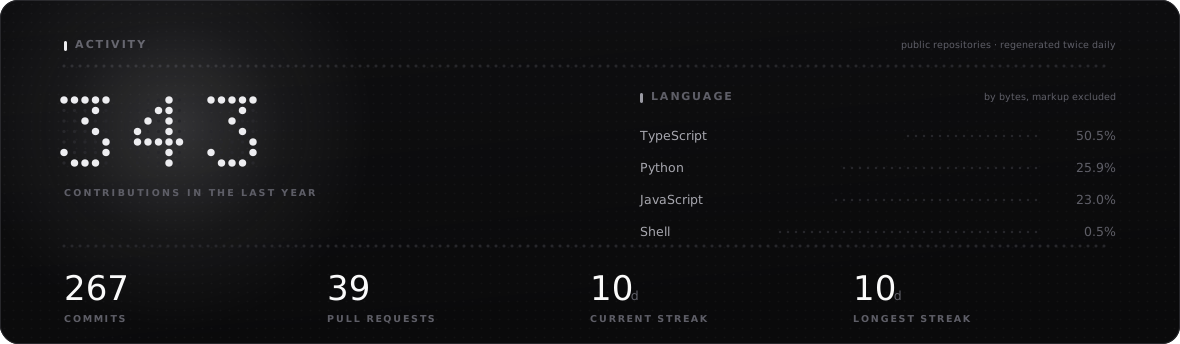
Every number on the right is in the repository it belongs to. Nothing here is a mockup.
Each of these started from a question that sounded simpler than it was, and in every case the popular tool was the wrong shape for it — a vector index cannot answer a five-hop traversal, and an exact-match cache key never hits on traffic nobody phrases the same way twice.
| LexisGuide React 19 · Bedrock Nova · DynamoDB · Base |
Reads the legal notice you were sent and finds the deadline buried in it. A router plus specialist agents, and every edit fingerprinted with SHA-256 onto a chain, so nothing can be quietly rewritten. Built for LexHack 2026. |
| DOCKET Next.js 15 · Strands Agents · Aurora DSQL |
The agent that reads city hall so a volunteer neighborhood group doesn't have to. Every claim links to its source document. 81 tests, 19 of 20 citations valid, and 5 of 5 correct refusals on the unanswerable questions. |
| FORGE Python 3.14 · FastAPI · OpenTelemetry |
Ships the feature, then audits itself and proves the hole is actually closed — tests passing and a fresh scan agreeing. 17 live checks, and it refuses the findings it should refuse. Stops at the pull request, deliberately. |
| Airlock TypeScript · Postgres · MCP |
Proves an irreversible production change on a shadow copy before anyone approves it: apply, undo, three checksums, and the gate opens only if pre == post_rollback. 201 tests across 24 suites. |
| Semantic Output Cache Postgres · pgvector · Redis |
Exact-match caches never hit on LLM traffic. This one embeds each output and serves it when cosine similarity clears a threshold. Redis is an accelerator, not a dependency. Key hashes stored, never keys. |
Also: blast-radius — npm supply-chain exposure as a graph traversal rather than a similarity search, 381 tests, built solo over a hackathon weekend · meridian — a financial terminal that tracks tax lots individually, because an average basis makes harvesting advice quietly wrong · Vivedly AI — a desktop coworker with a five-tier memory hierarchy instead of one vector store.
Four of the five are the same shape, and it is the shape I find most interesting: an agent allowed to do real work, with the proof — not the promise — standing between it and the thing it would change.
%%{init: {"theme": "base", "themeVariables": {
  "primaryColor": "#E9F3EA", "primaryTextColor": "#1B1C14",
  "primaryBorderColor": "#00674F", "lineColor": "#2F8A5E",
  "secondaryColor": "#FAF7EE", "tertiaryColor": "#FFFDF5",
  "fontFamily": "Inter, sans-serif" }}}%%
flowchart LR
    A["Agent<br/>proposes a change"] --> B["One doorway<br/>MCP tools, read-mostly"]
    B --> C["Sandbox<br/>apply, undo, checksum"]
    C -->|"pre == post_rollback"| D["Gate<br/>policy and quorum"]
    C -->|"drift"| X["Refused<br/>with the diff"]
    D --> E["Human decides<br/>against evidence"]
    E --> F["Sealed record<br/>hash-chained"]
The interesting part is never the model. It is that the approval is impossible to
construct without the proof: in Airlock the gate's rule is a module-private symbol only
openGate() can mint, so a non-proven approval is not greyed out or warned about — it
is unrepresentable in the type system.
| Languages | Python · TypeScript · SQL · Cypher · Solidity · Bash |
| Data | PostgreSQL · pgvector · DynamoDB · Aurora DSQL · S3 Vectors · SQLite · Redis |
| Agents & AI | AWS Bedrock (Nova, AgentCore) · Strands Agents · Claude API · MCP servers · embeddings and RAG |
| Interface | React 19 · Next.js 15 · Tailwind · Electron · vanilla JS with no build step |
| Infrastructure | AWS Lambda · S3 · CDK · Docker · FastAPI · Vercel · Amplify · GitHub Actions |
| Practice | pytest · Vitest · OpenTelemetry · CodeQL · groundedness evals · threat models in the repo |
| 📊 No mocked data, anywhere | Every number on every screen came back from a query that was actually run — including the empty states. A demo that lies is worse than no demo. |
| 📐 Measured, not claimed | If it says fast, there is a latency beside it. If it says safe, there is a checksum, an eval score, or a test id beside it. |
| 🔑 Secrets are a design problem | Not a checklist item at the end. The .gitignore globs exist because an explicit list already failed once, and the reasoning is written down in the file. |
| 📝 Commits explain the change | Not the diff. "Answer the lockfile question from the lockfile." You can read the history and know what happened. |
B.S. Computer Science — San Francisco Bay University, since 2025. Coursework in data structures, systems and databases; most of what is above was built outside of it, on weekends and at hackathons — LexHack 2026, Agents for Humans, Zero Downtime, Hack Hydra.

I move fast and I would rather build the hard version. If you are working on agent infrastructure, graph systems, or developer tooling — or you want someone who ships over a hackathon weekend and still writes the tests — I would like to hear from you.
rohitmaruriats@gmail.com · LinkedIn
Open to internships, hackathon teams, and OSS collaboration.
Ink, paper, sand, green, meadow, amber — the palette is LexisGuide's own.