
Your dashboard has been wrong since 03:00.
Hindsight walks your DataHub lineage to find what broke it, ranks who it hits, and writes the answer back into the catalog —
then re-reads every change through a different API to prove it landed. An agent that reports its own success proves nothing.


Video · Live demo · Install the Skill · Skill PR · Captured runs · Submission


▶ Watch the demo · 2:33
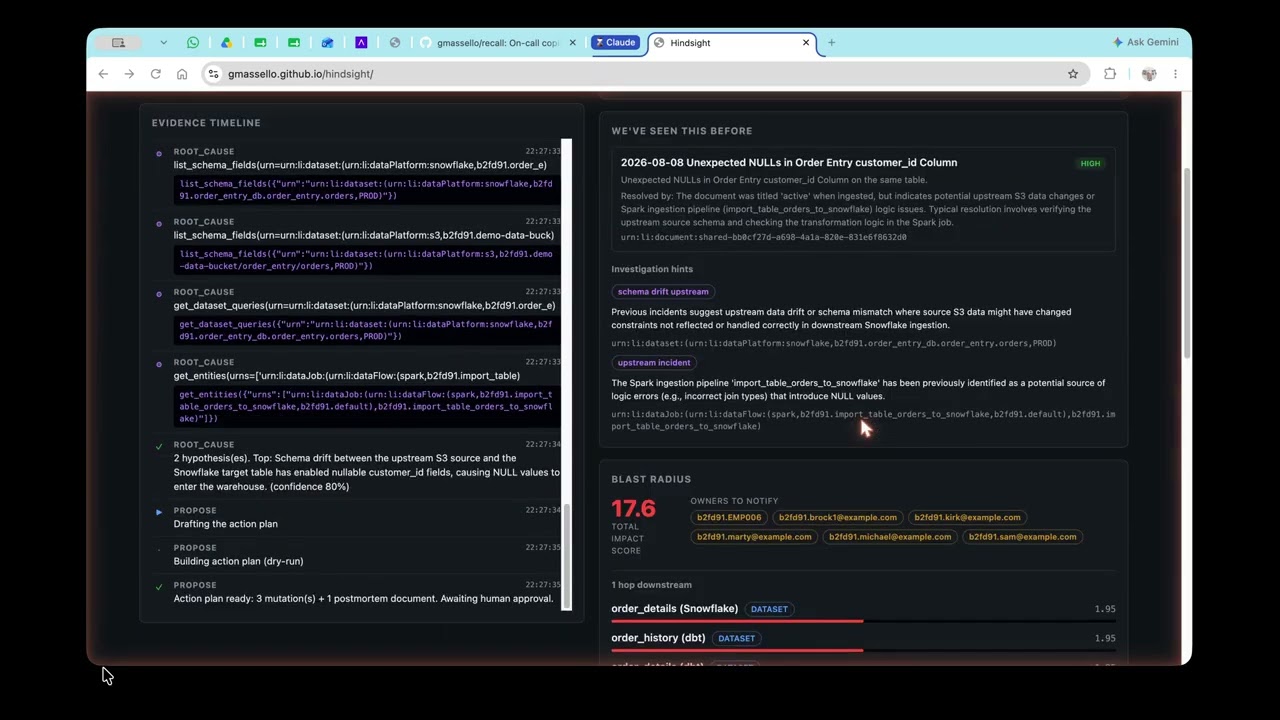
Data on-call, not ML drift. The alert is free text, the root cause is ranked and grounded in incidents you already solved, and the postmortem is filed inside DataHub — where the next investigation finds it. Built for the Build with DataHub: The Agent Hackathon, track Agents That Do Real Work.
cd backend && .venv/bin/hindsight replay ../examples/02-cold-vs-warm/warm   # ten seconds, no DataHub, no API key
npx skills add gmassello/hindsight # or run the same procedure in your own CLI, nothing cloned| Read Multi-hop lineage both directions, schema, query history — and the postmortems previous runs left behind. |
Act Deterministic blast-radius scoring, ranked hypotheses that must cite a URN a tool actually returned, and a mutation plan with a rationale per change. |
Write back Tags, an incident banner, ownership, and a postmortem document — all in the catalog, not a side database. |
And none of it is locked in this codebase. One command installs the same procedure as a portable Agent Skill into whatever CLI you already use — Claude Code, Cursor, Codex, Gemini CLI, Copilot and six more, no Python in the loop. Handed the same incident it reaches the same fourteen owners, set for set (the run), and it is proposed upstream to the official DataHub skills repo.
So it doesn't take its own word for it:
cd backend && .venv/bin/hindsight verify ../examples/01-schema-drift # → verified 5/5verify re-reads every mutation in a run's audit log straight from DataHub through the GMS GraphQL API — not the MCP tools that wrote it — and exits non-zero if anything is missing. It has already caught a real defect: examples/02-cold-vs-warm/cold/verify.txt reports verified 5/6, and the failure is a second run silently overwriting the first one's incident banner. Every run had reported success. The failing file ships as it came out.
That is the rule the product is built on: nothing counts until a second channel confirms it. Its companion is replay — the command at the top of this page — which reprints a captured run from its raw event stream, events.json. Clone the repo and watch a real investigation without installing anything.

| See the memory loop pay off | examples/02-cold-vs-warm — the second run retrieves the first one's postmortem out of the catalog: 20 tool calls cold vs. 15 warm |
| See it do real work | examples/01-schema-drift — 14 tool calls, 16 consumers, 10 owners paged, postmortem filed, verified 5/5 |
| See it work without our code | npx skills add gmassello/hindsight — the same procedure as a portable Agent Skill, proposed upstream; examples/04-skill-portability is the run that proves it |
Not a mock-up — DataHub's own UI after a run, and the app driving it.
 The tag. hindsight-degraded on the broken asset — and evidence for the next run's upstream-incident hypothesis. |
 The banner. Every consumer who opens the asset sees the incident at the top of the description. |
 The postmortem. A catalog document, not a side database — this is what recall retrieves next time. |
 The human gate. The plan as a dry-run diff, with a rationale per mutation. |
The live investigation view

# 1. Local DataHub with sample lineage  (needs Docker: 4 CPU / 8 GB)
uv tool install acryl-datahub
datahub docker quickstart                    # UI at localhost:9002 — datahub/datahub
datahub datapack load showcase-ecommerce     # then WAIT — see the note below

# 2. Backend
cd backend && uv sync
cp ../.env.example .env                      # set GEMINI_API_KEY (or anthropic / bedrock)

# 3. Investigate
.venv/bin/hindsight investigate \
  "orders table in order_entry_db is showing nulls in customer_id since 03:00 UTC today"
The CLI streams the timeline, renders the mutations as a dry-run diff, and applies them once you approve.
datapack loadreturns before the lineage graph exists. Ingestion reports success in under a second while the index fills in for minutes. A run started too early produces a real-looking investigation with a blast radius that is quietly wrong.
Then run it again. The second run's recall phase finds the postmortem the first one wrote and starts from its conclusions. That is the whole point.
Web UI, Docker and the API
cd backend && .venv/bin/hindsight serve      # FastAPI on :8000
cd frontend && npm install && npm run dev    # Vite on :5173
A single-page React app: submit an incident, watch the evidence timeline stream over SSE while panels fill in per phase — resolved asset, "we've seen this before", ranked blast radius, hypotheses with confidence bars, and the action plan as a diff with Approve / Reject. Set VITE_API_URL in frontend/.env if the API is elsewhere.
One command instead, with the DataHub quickstart already up:
GEMINI_API_KEY=<your-key> docker compose up --buildAPI surface: POST /investigations · GET /investigations/{id}/stream (SSE, up to the human gate) · POST /investigations/{id}/approve · POST /investigations/{id}/reject.
Prerequisites: Python 3.13+, uv, Node 20.19+. On colima, colima start --cpu 4 --memory 8. Every knob is in docs/configuration.md.

Five decisions carry the design:
- Memory before investigation.
recallruns beforeimpactandroot_cause, and what it finds becomesinvestigation_hintsthat steer where the search looks first. Memory drives the investigation instead of decorating it. - Per-phase toolsets. Investigation phases only ever see read tools; mutation tools exist only in
commit/learn. The model cannot write while it should be reading. - All math and writes are code. The LLM reports facts; the score is a formula and the mutations execute in code with an audit log.
impact(consumer) = type_weight × 1/(1+hops) × owner/criticality/domain multipliers. - Grounded hypotheses, and a verdict that can decline. Every hypothesis must cite a URN a tool actually returned. An
exoneratedverdict forces the action plan empty in code, not by asking the model nicely. - Grounded mutations only.
proposesees the live mutation schemas and a whitelist of URNs the investigation saw. A mutation it cannot ground in a real URN is dropped, not guessed.
Plus a human gate by default (--auto-approve opts out), a deterministic state machine rather than a free ReAct loop, and MCP-first DataHub access via mcp-server-datahub with a GMS GraphQL fallback per mutation. Full rationale in docs/design.md.
The postmortem is a DataHub document. Not a SQLite file, not a vector store, not a table only this agent can read — a catalog entity that search_documents returns to whoever asks: the next run, a different agent, or the engineer who opens the UI at 03:00 next quarter. Nothing here is memory about DataHub; it is memory inside it.
That is what makes the write-back compound. An ancestor already tagged hindsight-degraded is evidence for the next run's upstream-incident hypothesis — the system reads its own past actions through the same tools anyone else would use.

It also buys speed, and that part is not free. The warm run was cheaper and narrower — 6 consumers swept against the cold run's 29. Both converged on the same ancestor, but a warm run trusts memory instead of re-deriving the blast radius. That tradeoff is the honest version of this graph.
| Mutation | Where it lands | Who inherits it |
|---|---|---|
add_tags hindsight-degraded |
Tags on the broken asset | Anyone who opens or searches it — and the next run, as evidence |
add_tags hindsight-impacted |
Tags on the top-scoring consumers | Downstream owners, through search facets |
update_description |
Incident banner atop the asset description | Every consumer who opens the asset in the UI |
add_owners |
Ownership on an ungoverned asset in the path | The governance backlog, permanently |
set_domains |
Domain assignment | Implemented, never triggered — see Honest limits |
save_document |
A postmortem document in the catalog | The next investigation's recall phase |
| DataHub gives you | Hindsight adds |
|---|---|
| Impact Analysis lists downstream entities | A ranking over them by a deterministic score, and the deduplicated owner list you actually have to page |
| A lineage graph you can walk by hand | An agent that walks it both directions from a free-text alert and cites the URNs behind each hypothesis |
| Documents you can write | A postmortem the next investigation retrieves and acts on — memory, not documentation |
.agents/skills/datahub-incident-triage/ distills the agent into an Agent Skills package: the same seven-step procedure as plain instructions, no Python. One command puts it in whatever CLI you already have.
npx skills add gmassello/hindsightThat detects the agents installed on the machine and writes the skill for each — on this one it covered eleven, Claude Code, Cursor, Codex, Gemini CLI, GitHub Copilot, Warp and OpenCode among them. To place it by hand instead:
| Agent | Path |
|---|---|
| Claude Code | .claude/skills/ |
| Cursor, GitHub Copilot, Codex, Gemini CLI | .agents/skills/ |
| Windsurf | .windsurf/skills/ |
Then hand it an incident the way you would hand one to a person:
> orders in order_entry_db is showing NULL values in customer_id since 03:00 UTC
> triage this: {"asset": "analytics.order_history", "check": "freshness", "status": "fail"}
examples/04-skill-portability is exactly that, captured: scenario 1 handed to an agent following only SKILL.md, no Python in the loop. It names the backend run's conclusion as its own second hypothesis, and documents the caveats and the three defects verification surfaced in the skill.
What the skill cannot give you, and this repo does. Instructions can describe the impact formula; they cannot execute it — the scores in that run were computed by hand from the skill's own reference. Everything that makes a claim checkable lives in the code: verify re-reading each mutation through GraphQL, replay reprinting a run from its raw event stream, the audit log, the approval gate enforced in code rather than requested in prose, and the GraphQL fallback when a mutation fails over MCP. The skill is the door; the repo is the guarantee.
Every number above comes from a file in this repository.
| Claim | Evidence |
|---|---|
| 13 MCP tools, read and mutation, multi-hop lineage both directions | 02-cold-vs-warm/cold/timeline.md — 20 tool calls, 29 consumers |
| Blast radius ranked by a deterministic formula, with the owner list to page | 02-cold-vs-warm/cold/blast-radius.md — total score 30.08, 14 deduplicated owners |
| The same incident costs 20 tool calls cold and 15 warm — and sweeps 29 consumers vs. 6 | 02-cold-vs-warm/ |
| Every mutation re-read through a second channel, GraphQL rather than the MCP tools that wrote it | 01-schema-drift/verify.txt — verified 5/5 |
| Verification catches what the agent misses | 02-cold-vs-warm/cold/verify.txt — verified 5/6, the banner overwritten |
| Five runs against a live catalog across four directories | examples/ |
| The procedure runs with no Hindsight code in the loop — same URN, converging root cause, the same fourteen owners, set for set | 04-skill-portability/ |
| The skill is proposed upstream to the official DataHub skills repo | datahub-project/datahub-skills#110 |
The five captured runs, one row each
scenarios/scenarios.yaml defines three reproducible scenarios; examples/ holds five captured runs across four directories, each with its input, timeline, blast radius, postmortem and audit log. Four were written by hindsight investigate ... --report <dir> and ship their raw event stream; the fifth is a run of the Skill alone, transcribed by hand.
| Run | Tool calls | Consumers | Impact score | Deduped owners | verify |
|---|---|---|---|---|---|
01-schema-drift |
14 | 16 | 17.0 | 10 | verified 5/5 |
02-cold-vs-warm/cold |
20 | 29 | 30.08 | 14 | verified 5/6 |
02-cold-vs-warm/warm |
15 | 6 | 17.55 | 6 | verified 8/9 |
03-orphaned-asset |
17 | 0 (leaf asset) | 0.0 | none | verified 4/4 |
04-skill-portability |
9 investigation (14 total) | 30 | 26.23 | 14 | — |
01-schema-drift— a simulated upstream migration drops thecustomer_idNOT NULL constraint; the agent traces the nulls to a Postgres ancestor a previous run had already taggedhindsight-degraded.02-cold-vs-warm★ — the same incident twice, timelines side by side.03-orphaned-asset— a stale table nobody owns and nobody consumes; the agent assignsadd_ownersto close the governance gap.04-skill-portability— scenario 1 re-run by the Skill alone, no Python in the loop.
scenarios/seed_incidents.py loads six resolved historical postmortems so recall has memory to work with.
- The phase prompts are not covered by tests. Everything under Tests is; the prompts are verified only by the captured runs.
- Every number in
examples/comes from a single run. 20 → 15 is one pair against one catalog, not a measurement with a variance. - Memory bought speed and cost coverage. The warm run swept 6 consumers where the cold run swept 29. Faster is not the same as more thorough.
proposeis not deterministic. Scenario 3 run twice producedadd_ownersonce and not the other time, on an asset that demonstrably had no owner.- The
exoneratedverdict has never fired. Exonerating requires evidence of health, and this catalog carries no freshness timestamps, no row counts and no job run history. The verdict is implemented and untriggerable here. - Two runs against the same asset overwrite each other's incident banner. Found by
verify, not by the author —02-cold-vs-warm/cold/verify.txt,verified 5/6. - Hindsight does not detect incidents. It receives an alert and investigates it. Monitoring is one of the six items in the out-of-scope table of
docs/design.md§3, Scope: what is in and what is out. - The API keeps investigations in an in-memory dict — no auth, no persistence. Restarting loses them. This is a demo, not a SaaS.
set_domainshas never fired. Implemented, but the prompt forbids inventing a domain URN and no run retrieved one — the domain URNs in this catalog are UUIDs.- Nothing has run against a second catalog. One warehouse, one datapack.
cd backend
.venv/bin/ruff check src tests
.venv/bin/pytest
Unit tests mock the LLM and MCP client. Covered: the scoring formula, the phase loop guards, the Gemini schema normalization, postmortem rendering, the report writer, verify, replay, and the orchestrator's failure policy.
docs/design.md— the design doc frozen before implementation. Good for the why; it describes what was planned, this file describes what was built.docs/notes-from-the-build.md— eight traps that cost hours against a real DataHub and a real model, written down so they cost you minutes.docs/configuration.md— every environment variable, and the repo layout.SUBMISSION.md— delivery status.- The overview page — the same story on one page, for linking from outside the repo.
Apache 2.0