This is a fork of encode/broadcaster.
Broadcaster helps you develop realtime streaming functionality by providing a simple broadcast API onto a number of different backend services.
It currently supports Redis PUB/SUB, Apache Kafka, Apache Pulsar and Postgres LISTEN/NOTIFY, plus a simple in-memory backend, that you can use for local development or during testing.
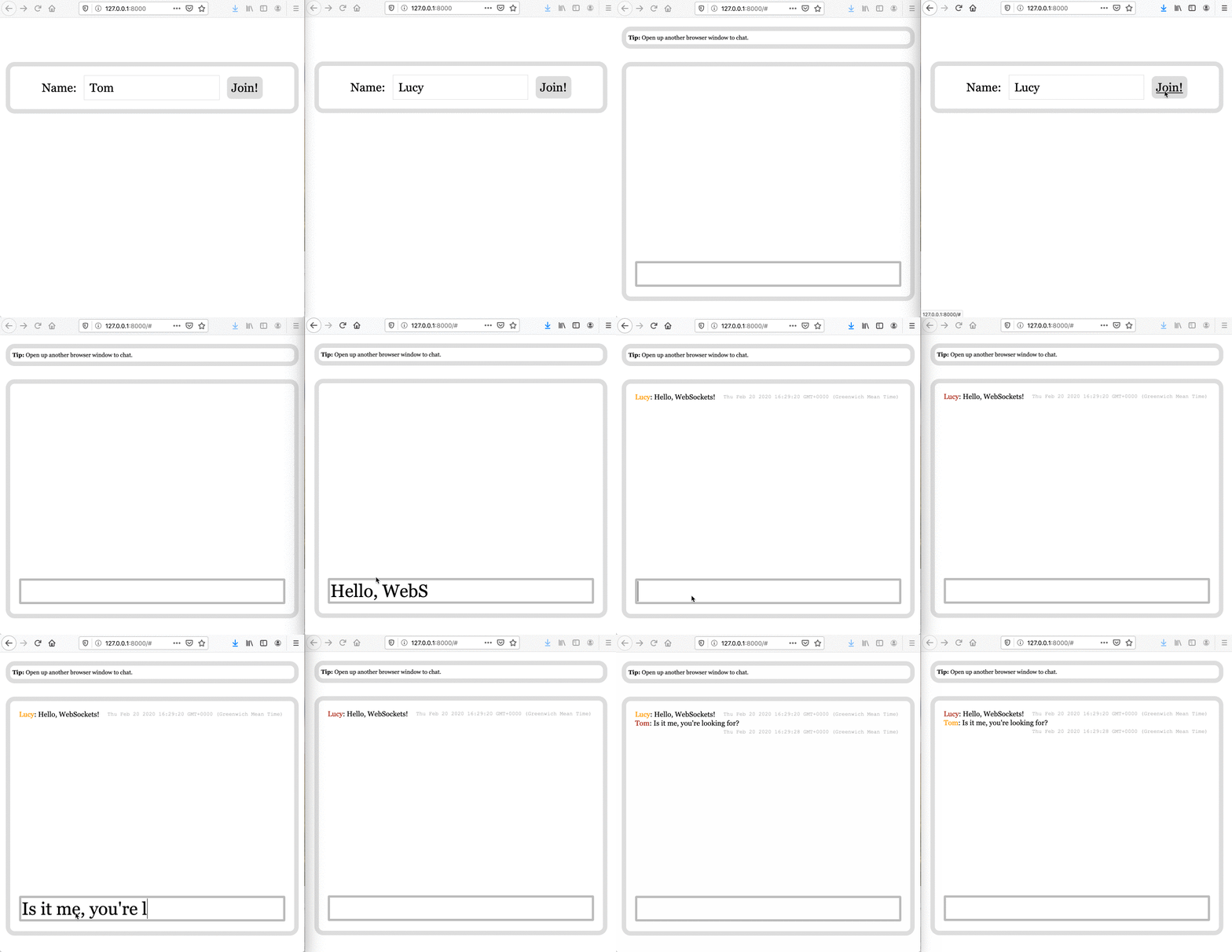
Here's a complete example of the backend code for a simple websocket chat app:
app.py
# Requires: `starlette`, `uvicorn`, `jinja2`
# Run with `uvicorn example:app`
from broadcaster import Broadcast
from starlette.applications import Starlette
from starlette.concurrency import run_until_first_complete
from starlette.routing import Route, WebSocketRoute
from starlette.templating import Jinja2Templates


broadcast = Broadcast("redis://localhost:6379")
templates = Jinja2Templates("templates")


async def homepage(request):
    template = "index.html"
    context = {"request": request}
    return templates.TemplateResponse(template, context)


async def chatroom_ws(websocket):
    await websocket.accept()
    await run_until_first_complete(
        (chatroom_ws_receiver, {"websocket": websocket}),
        (chatroom_ws_sender, {"websocket": websocket}),
    )


async def chatroom_ws_receiver(websocket):
    async for message in websocket.iter_text():
        await broadcast.publish(channel="chatroom", message=message)


async def chatroom_ws_sender(websocket):
    async with broadcast.subscribe(channel="chatroom") as subscriber:
        async for event in subscriber:
            await websocket.send_text(event.message)


routes = [
    Route("/", homepage),
    WebSocketRoute("/", chatroom_ws, name='chatroom_ws'),
]


app = Starlette(
    routes=routes, on_startup=[broadcast.connect], on_shutdown=[broadcast.disconnect],
)
The HTML template for the front end is available here, and is adapted from Pieter Noordhuis's PUB/SUB demo.
Python 3.7+
pip install permit-broadcasterpip install permit-broadcaster[redis]pip install permit-broadcaster[pulsar]pip install permit-broadcaster[postgres]pip install permit-broadcaster[kafka]
Broadcast('memory://')Broadcast("redis://localhost:6379")Broadcast("pulsar://localhost:6650")Broadcast("postgres://localhost:5432/broadcaster")Broadcast("kafka://localhost:9092")Broadcast("kafka://broker_1:9092,broker_2:9092")
A LISTEN connection is idle by nature: it sends nothing and waits for NOTIFYs. If the
server's address goes silent without closing the socket (e.g. an RDS Multi-AZ failover, a
network partition) the client never receives a FIN/RST, the socket stays ESTABLISHED, and
the listener is deaf with no error. asyncpg exposes no keepalive option, so the Postgres
backend enables TCP keepalive on every pooled connection itself. It is on by default
(idle 30 s, 10 s between probes, 3 lost probes → the connection errors within ~60 s of the
peer going silent and the subscriber is notified). Tune or disable it with the libpq
parameter names in the URL (they are stripped before the URL reaches asyncpg):
postgres://user:pw@host:5432/db?keepalives=1&keepalives_idle=30&keepalives_interval=10&keepalives_count=3
postgres://user:pw@host:5432/db?keepalives=0     # disable
The existing BROADCASTER_PG_MAX_POOL_SIZE environment variable still controls the pool size.
The following environment variables are exposed to allow SASL authentication with Kafka (along with their default assignment):
KAFKA_SECURITY_PROTOCOL=PLAINTEXT   # PLAINTEXT, SASL_PLAINTEXT, SASL_SSL
KAFKA_SASL_MECHANISM=PLAIN   # PLAIN, SCRAM-SHA-256, SCRAM-SHA-512
KAFKA_PLAIN_USERNAME=None   # any str
KAFKA_PLAIN_PASSWORD=None   # any str
KAFKA_SSL_CAFILE=None   # CA Certificate file path for kafka connection
KAFKA_SSL_CAPATH=None   # Path to directory of trusted PEM certificates for kafka connection
KAFKA_SSL_CERTFILE=None   # Public Certificate path matching key to use for Kafka connection in PEM format
KAFKA_SSL_KEYFILE=None   # Private key path to use for Kafka connection in PEM format
KAFKA_SSL_KEY_PASSWORD=None   # Private key password
For full details refer to the (AIOKafka options)[https://aiokafka.readthedocs.io/en/stable/api.html#producer-class] where the variable name matches the capitalised env var with an additional KAFKA_ prefix.
For SSL properties see (AIOKafka SSL Context)[https://aiokafka.readthedocs.io/en/stable/api.html#aiokafka.helpers.create_ssl_context].
Support for Apache Pulsar, a distributed messaging system, has been added.
To use Pulsar as a backend, ensure you have the necessary package installed:
pip install permit-broadcaster[pulsar]You will also need a running Pulsar instance. Follow the official Pulsar installation guide for detailed setup instructions. You can also start Pulsar via Docker using the provided docker-compose.yaml file in the repository:
docker-compose up pulsar
# The same applies for other services...
In the Available backends section, add:
Broadcast("pulsar://localhost:6650")Ensure you have a Pulsar server running before executing this example.
- Added Pulsar: Apache Pulsar is now available as a backend in Broadcaster.
At the moment broadcaster is in Alpha, and should be considered a working design document.
The API should be considered subject to change. If you do want to use Broadcaster in its current
state, make sure to strictly pin your requirements to broadcaster==0.2.0.
To be more capable we'd really want to add some additional backends, provide API support for reading recent event history from persistent stores, and provide a serialization/deserialization API...
- Serialization / deserialization to support broadcasting structured data.
- Backends for Redis Streams, Apache Kafka, and RabbitMQ.
- Add support for
subscribe('chatroom', history=100)for backends which provide persistence. (Redis Streams, Apache Kafka) This will allow applications to subscribe to channel updates, while also being given an initial window onto the most recent events. We might also want to support some basic paging operations, to allow applications to scan back in the event history. - Support for pattern subscribes in backends that support it.